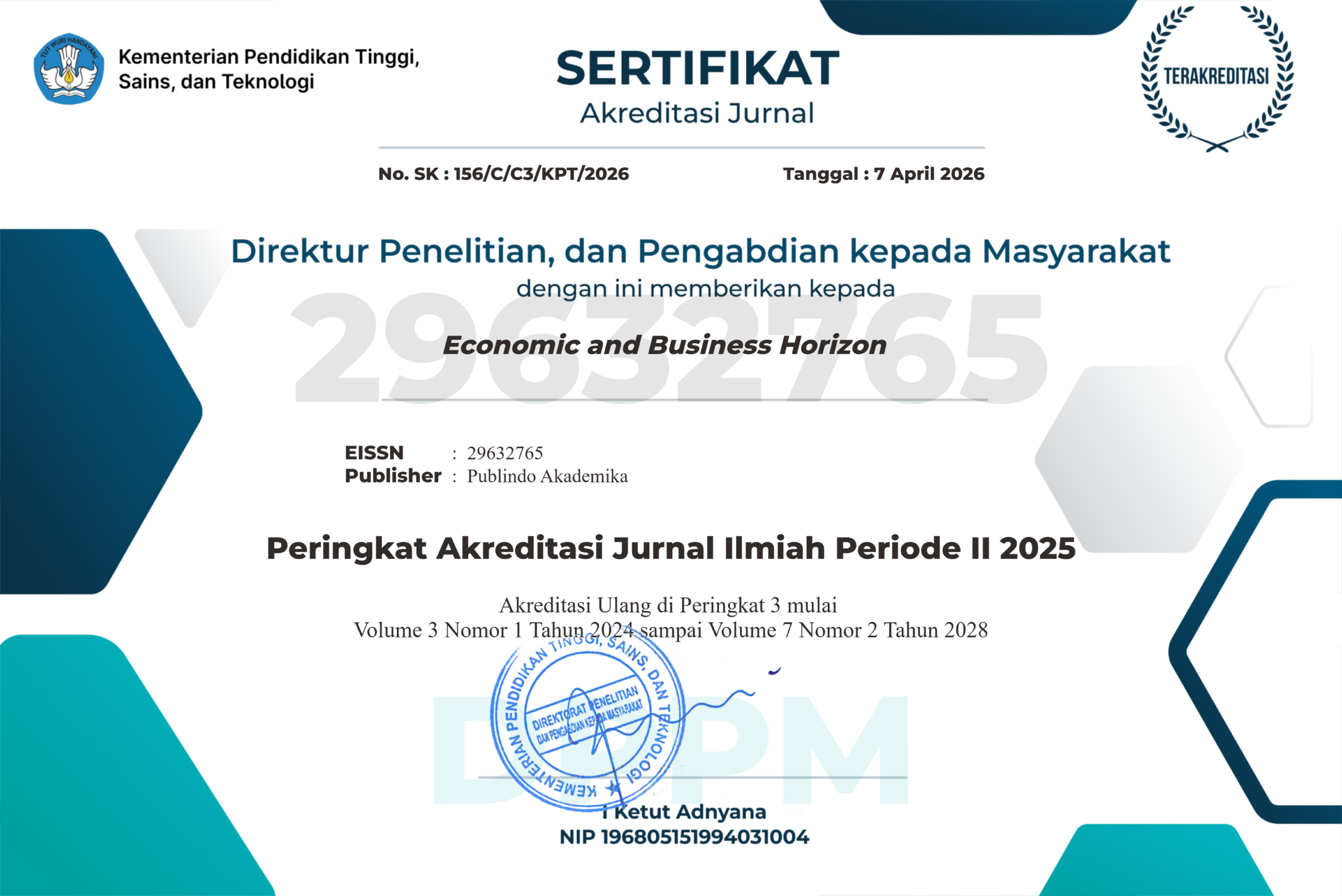
Fluid Workers in Indonesia: Benefits, Challenges, and Needs in Digitalization Era
DOI:
https://doi.org/10.54518/ebh.4.2.2025.628Keywords:
Fluid Workers, Digitalization, Workplace Flexibility, Employment Challenges, Indonesia Labor MarketAbstract
The dynamic modern workplace and digitalization change the workforce from rigid to liquid workforces. Therefore, this study aims to unravel the characteristics, benefits, and challenges of fluid workers in Indonesia using a qualitative method. For these motivations, structured questionnaires with dichotomous questions were distributed to collect primary data. To avoid biased results, study participants are chosen rigorously. The number of participants was 15 workers from various institutions. The findings show that most fluid workers in Indonesia are adaptive, easy to collaborate with, tech-savvy, lifelong learners, and resilient. The current benefits of fluid workers include skill and knowledge exposure, networking possibilities, the prospect of higher income, and flexibility. In terms of challenges, a lack of benefits and limited social support are two factors that impede fluid workers. Surprisingly, job insecurity and income instability are not the primary concerns for fluid workers, indicating that fluid workers differ significantly from informal workers. The priority needs of fluid workers are the right to rest and leisure, equal treatment, fair compensation, and career development opportunities.
References
Agrawal, A., Horton, J., Lacetera, N., & Lyons, E. (2015). Digitization and the contract labor market: A research agenda. Economic analysis of the digital economy. Economic Analysis of the Digital Economy 5 (2), 35.
Ahmad, N. (2021). Gig Workers: The New Employment Form in the New Economy. Ulum Islamiyyah, 33(S4), 131–145.
Akour, M., & Alenezi, M. (2022). Higher Education Future in the Era of Digital Transformation. Education Sciences, 12(11).
Akpan, I. J., Udoh, E. A. P., & Adebisi, B. (2022). Small business awareness and adoption of state-of-the-art technologies in emerging and developing markets, and lessons from the COVID-19 pandemic. Journal of Small Business & Entrepreneurship, 34(2), 123–140.
Ashford, S. J., Caza, B. B., & Reid, E. M. (2018). From surviving to thriving in the gig economy: A research agenda for individuals in the new world of work. Research in Organizational Behavior, 38, 23–41.
Asian Development Bank, & BPS-Statistic. (2011). The Informal Sector and Informal Employment in Indonesia. Available at: www.adb.org.
Bai, C., Quayson, M., & Sarkis, J. (2021). COVID-19 pandemic digitization lessons for sustainable development of micro-and small- enterprises. Sustainable Production and Consumption, 27, 1989–2001.
Baines, S., & Robson, L. (2001). Being self‐employed or being enterprising? the case of creative work for the media industries. Journal of Small Business and Enterprise Development, 8(4), 349–362.
Balsmeier, B., & Woerter, M. (2019). Is this time different? How digitalization influences job creation and destruction. Research Policy, 48(8), 103765.
Bari, N., Chimhundu, R., & Chan, K. C. (2022). Dynamic Capabilities to Achieve Corporate Sustainability: A Roadmap to Sustained Competitive Advantage. Sustainability (Switzerland), 14(3).
Boyle, K. J. (1990). Dichotomous-choice, contingent-valuation questions: Functional form is important. Northeastern Journal of Agricultural and Resource Economics, 19(2), 125–131.
Bradshaw, C., Atkinson, S., & Doody, O. (2017). Employing a Qualitative Description Approach in Health Care Research. Global Qualitative Nursing Research, 4, 2333393617742282.
Bryant, A. (2020). Liquid uncertainty, chaos and complexity: The gig economy and the open source movement. Thesis Eleven, 156(1), 45–66.
Burke, A., & Cowling, M. (2020). The relationship between freelance workforce intensity, business performance and job creation. Small Business Economics, 55(2), 399–413.
Capgemini Research Institute. (2020). The Fluid WOrkforce Revolution. Available at: https://www.capgemini.com/insights/research-library/fluid-workforce/
Chafi, M. B., Hultberg, A., & Yams, N. B. (2022). Post-pandemic office work: Perceived challenges and opportunities for a sustainable work environment. Sustainability (Switzerland), 14(1), 1–20.
Chen, B., Liu, T., & Wang, Y. (2020). Volatile fragility: new employment forms and disrupted employment protection in the new economy. International Journal of Environmental Research and Public Health, 17(5), 1531.
Crouch, M., & McKenzie, H. (2006). The logic of small samples in interview-based qualitative research. Social Science Information, 45(4), 483–499.
Dartanto, T., Rezki, J. F., Pramono, W., Siregar, C. H., Usman, & Bintara, H. (2016). Participation of Informal Sector Workers in Indonesia’s National Health Insurance System. Southeast Asian Economies, 33(3), 317–342.
Donthu, N., & Gustafsson, A. (2020). Effects of COVID-19 on business and research. Journal of Business Research, 117, 284–289.
Erjavec, K., Janžekovič, M., Kovač, M., Simčič, M., Mergeduš, A., Terčič, D., & Klopčič, M. (2021). Changes in use of communication channels by livestock farmers during the covid-19 pandemic. Sustainability (Switzerland), 13(18).
Ernst, E., Merola, R., & Samaan, D. (2019). Economics of Artificial Intelligence: Implications for the Future of Work. IZA Journal of Labor Policy, 9(1).
Golden, L. (2012). The effects of working time on productivity and firm performance, research synthesis paper. International Labor Organization (ILO) Conditions of Work and Employment Series, (33).
Harsch, K., & Festing, M. (2020). Dynamic talent management capabilities and organizational agility—A qualitative exploration. Human Resource Management, 59(1), 43–61.
Johnstone, M.-L. (2017). Depth Interviews and Focus Groups BT - Formative Research in Social Marketing: Innovative Methods to Gain Consumer Insights (K. Kubacki & S. Rundle-Thiele (eds.); pp. 67–87). Springer Singapore.
Jurnalita, A. C. (2024). The Impact of Digital Transformation on MSME Competitiveness and Economic Growth. Arthatama: Journal of Business Management and Accounting, 8(2), 95-106.
Klaser, K., Cuel, R., & Casari, P. (2023). The future of hybrid work in Italy: A survey-based Socio-Technical-System analysis. Journal of Innovation & Knowledge, 8(4), 100426.
Krajčík, M., Schmidt, D. A., & Baráth, M. (2023). Hybrid Work Model: An Approach to Work–Life Flexibility in a Changing Environment. Administrative Sciences, 13(6).
Lee, S., McCann, D., & Messenger, J. C. (2007). Working Time Around the World: Trends in working hours, laws and policies in a global comparative perspective. Working Time Around the World: Trends in Working Hours, Laws and Policies in a Global Comparative Perspective, 1–220.
Leggett, E. R. (2020). Digitization and digital archiving: a practical guide for librarians. Rowman & Littlefield Publishers.
Lund, F. (2012). Work-related social protection for informal workers. International Social Security Review, 65(4), 9–30.
Luoh, H. F., Tsaur, S. H., & Tang, Y. Y. (2014). Empowering employees: Job standardization and innovative behavior. International Journal of Contemporary Hospitality Management, 26(7), 1100–1117.
Mai, Q. D. (2021). Unclear signals, uncertain prospects: The labor market consequences of freelancing in the new economy. Social Forces, 99(3), 895–920.
Marjanovic, O., & Murthy, V. (2022). The Emerging Liquid IT Workforce: Theorizing Their Personal Competitive Advantage. Information Systems Frontiers, 24(6), 1775–1793.
May, T., Warran, K., Burton, A., & Fancourt, D. (2022). Socioeconomic and Psychosocial Adversities Experienced by Freelancers Working in the UK Cultural Sector During the COVID-19 Pandemic: A Qualitative Study. Frontiers in Psychology, 12(January), 1–11.
Nawaz, Z., Zhang, J., Mansoor, R., Hafeez, S., & Ilmudeen, A. (2020). Freelancers as Part-time Employees: Dimensions of FVP and FJS in E-Lancing Platforms. South Asian Journal of Human Resources Management, 7(1), 34–60.
Noerhartati, E., Saurina, N., & Idris, A. (2023). Evaluating User Satisfaction and Educational Impact of the Sorghum Entrepreneur Marketplace: An Application of the Pieces Framework. Research Horizon, 3(6), 668-679.
Nugroho, A. A. (2018). Labor Market Flexibility: Advantages for Workforce or Threat? Policy & Governance Review, 2(2), 132.
O’Reilly, M., & Parker, N. (2012). ‘Unsatisfactory Saturation’: a critical exploration of the notion of saturated sample sizes in qualitative research. Qualitative Research, 13(2), 190–197.
Osborne, N., & Grant-Smith, D. (2021). In-Depth Interviewing BT - Methods in Urban Analysis (S. Baum (ed.); pp. 105–125). Springer Singapore. h
Patten, M. (2020). Planning Questionnaire Research. Questionnaire Research, 7–14.
Pitoyo, A. J., Aditya, B., Amri, I., & Rokhim, A. A. (2021). Impacts and Strategies Behind COVID-19-Induced Economic Crisis: Evidence from Informal Economy. The Indian Journal of Labour Economics, 64(3), 641–661.
Porath, U. (2023). Advancing Managerial Evolution and Resource Management in Contemporary Business Landscapes. Modern Economy, 14(10), 1404–1420.
Rajendran, J. A., Baharin, H., & Mohmad Kamal, F. (2019). Understanding Instant Messaging in the Workplace BT - Advances in Visual Informatics. In H. Badioze Zaman, A. F. Smeaton, T. K. Shih, S. Velastin, T. Terutoshi, N. Mohamad Ali, & M. N. Ahmad (Eds.), Advances in Visual Informatics (pp. 640–652). Springer International Publishing.
Ramadhani, R. (2024). Big Data in Digital Transformation of Corporate Marketing Strategy. Economic and Business Horizon, 3(1), 24-28.
Rashmi, L. N. E., Raina, A., Shukla, R., & Meharunisa, S. (2023). The Future of Work: Adapting Management Practices to the Gig Economy and Freelancer Culture. European Economic Letters (EEL), 13(3 SE-Articles), 1131–1139.
Rodríguez, R. S. R. (2021). Characteristics of a liquid workforce. Ifeel.
Roos, G., Oláh, J., Ingle, R., Kobayashi, R., & Feldt, M. (2020). Online conferences – Towards a new (virtual) reality. Computational and Theoretical Chemistry, 1189, 112975.
Rossingol, N. (2024, January 18). From Rigid to Fluid: The Rise of the Liquid Workforce. Available at: https://www.runn.io/blog/liquid-workforce
Rotatori, D., Lee, E. J., & Sleeva, S. (2021). The evolution of the workforce during the fourth industrial revolution. Human Resource Development International, 24(1), 92–103.
Rothenberg, A. D., Gaduh, A., Burger, N. E., Chazali, C., Tjandraningsih, I., Radikun, R., Sutera, C., & Weilant, S. (2016). Rethinking Indonesia’s Informal Sector. World Development, 80, 96–113. h
Sánchez-Hernández, M. I., González-López, Ó. R., Buenadicha-Mateos, M., & Tato-Jiménez, J. L. (2019). Work-life balance in great companies and pending issues for engaging new generations at work. International Journal of Environmental Research and Public Health, 16(24), 5122.
Santoso, R. P., Sahadewo, G. A., Sugiyanto, C., & Setiastuti, S. U. (2022). Informal and Formal Wage Differences Based on Cohorts in Indonesia. Economies, 10(12), 1–13.
Shepheard, M. (2020). Technology and the future of the government workforce - How new and emerging technology will change the nature of work in government. Available at: www.instituteforgovernment.org.uk
Sibagariang, F. A., Mauboy, L. M., Erviana, R., & Kartiasih, F. (2023). Gambaran Pekerja Informal dan Faktor-Faktor yang Memengaruhinya di Indonesia Tahun 2022. Seminar Nasional Official Statistics, 2023(1), 151–160.
Singh, D. V. (2021). Technology, Future of Work and Ageing Workforce Readiness. International Journal of Systematic Innovation, 6(4), 55–63.
Srinivasan, V. (2012). Multi generations in the workforce: Building collaboration. IIMB Management Review, 24(1), 48–66.
Starr, M. A. (2014). Qualitative and mixed-methods research in economics: surprising growth, promising future. Journal of Economic Surveys, 28(2), 238–264.
Syed, I., Daly, T., Armstrong, P., Lowndes, R., Chadoin, M., & Naidoo, V. (2016). How do work hierarchies and strict divisions of labour impact care workers’ experiences of health and safety? Case studiesof long term care in toronto. The Journal of Nursing Home Research Sciences, 2(1), 41–49.
Szymkowiak, A., Melović, B., Dabić, M., Jeganathan, K., & Kundi, G. S. (2021). Information technology and Gen Z: The role of teachers, the internet, and technology in the education of young people. Technology in Society, 65, 101565.
Takeda, A., Truong, H. T., & Sonobe, T. (2022). The impacts of the COVID-19 pandemic on micro, small, and medium enterprises in Asia and their digitalization responses. Journal of Asian Economics, 82, 101533.
Thompson, L. J., Glewen, K. L., Elmore, R. W., Rees, J., Pokal, S., & Hitt, B. D. (2019). Farmers as Researchers: In-depth Interviews to Discern Participant Motivation and Impact. Agronomy Journal, 111(6), 2670–2680.
Tomaszewski, L. E., Zarestky, J., & Gonzalez, E. (2020). Planning Qualitative Research: Design and Decision Making for New Researchers. International Journal of Qualitative Methods, 19, 1609406920967174.
van de Weerd, I., Mangula, I. S., & Brinkkemper, S. (2016). Adoption of software as a service in Indonesia: Examining the influence of organizational factors. Information & Management, 53(7), 915–928.
Wahab, H. A., Wahed, H., & Razak, S. S. A. (2024). Flexible Work Arrangements and the Legal Considerations in Malaysia (Vol. 2023, Issue Uumilc 2023). Atlantis Press International BV.
Wenzel, M., Senf, N. N., & Koch, J. (2016). Exploring complex phenomena with qualitative research methods: an examination of strategic innovation trajectories in haute cuisine. Complexity in Entrepreneurship, Innovation and Technology Research: Applications of Emergent and Neglected Methods, 163–182.
Widyastuti, D. A. R., Wahyuni, H. I., & Wastutiningsih, S. P. (2023). Creating a digital ecosystem for sustainable development: Insights from Indonesian micro, small and medium enterprises. Kasetsart Journal of Social Sciences, 44(1), 27–38.
Williamson, B., Eynon, R., & Potter, J. (2020). Pandemic politics, pedagogies and practices: digital technologies and distance education during the coronavirus emergency. Learning, Media and Technology, 45(2), 107–114.
Wontorczyk, A., & Rożnowski, B. (2022). Remote, hybrid, and on-site work during the SARS-CoV-2 pandemic and the consequences for stress and work engagement. International Journal of Environmental Research and Public Health, 19(4), 2400.
World Economic Forum. (2020). The Future of Jobs Report 2020. The Future of Jobs Report, October, 1163.
Yi, K. (2022). How Does Authoritarian Leadership Influence Employees and Organisation? Atlantis Press SARL.
Zhang, R. (Renata), & Abd Rahman, A. (2022). Dive in the flow experience: millennials’ tech-savvy, satisfaction and loyalty in the smart museum. Current Issues in Tourism, 25(22), 3694–3708.

Downloads
Published
How to Cite
Issue
Section
License

This work is licensed under a Creative Commons Attribution-ShareAlike 4.0 International License.