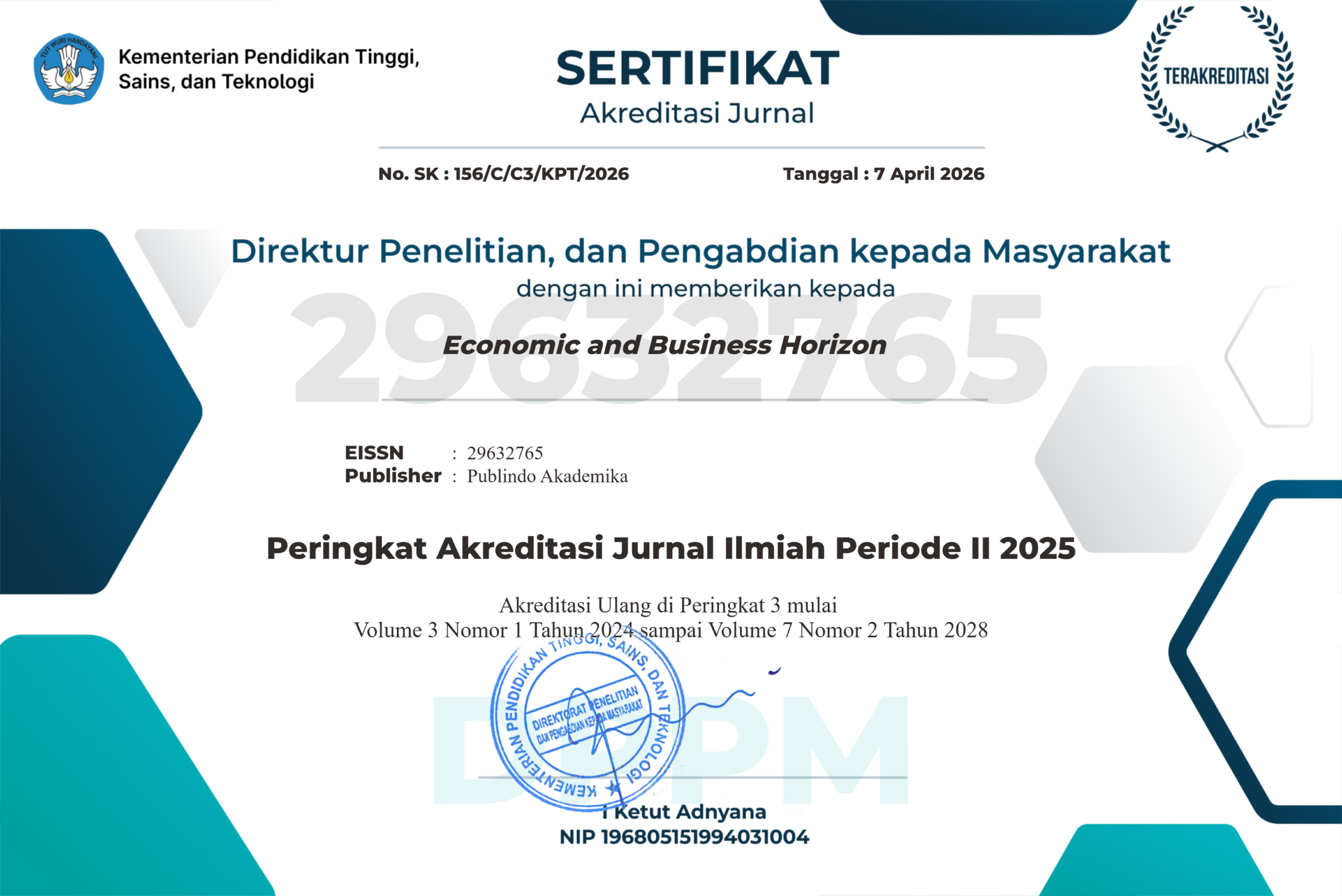
The Effect of Kaizen, Lean Accounting, and Six Sigma on Internal Audit Effectiveness with SBSC as Moderator
DOI:
https://doi.org/10.54518/ebh.5.2.2026.1117Keywords:
Internal Audit Effectiveness, Kaizen, Lean Accounting, Six Sigma, Sustainability Balanced ScorecardAbstract
This study investigates the effectiveness of internal audit functions in state-owned enterprises particularly in addressing ongoing fraud issues and deficiencies in internal control systems. The primary objective is to empirically evaluate the impact of kaizen, lean accounting, and six sigma on internal audit effectiveness, while incorporating the Sustainability Balanced Scorecard (SBSC) as a moderating variable. The research adopts a quantitative explanatory approach, utilizing purposive sampling to obtain data from 100 employees within State-Owned Enterprises. The analysis is conducted using Moderated Regression Analysis (MRA) with SPSS software. The results indicate that kaizen, lean accounting, and six sigma each exert a positive and statistically significant influence on internal audit effectiveness. Among these approaches, six sigma emerges as the most influential factor, as reflected by its highest coefficient and level of significance. In addition, SBSC is found to significantly enhance the relationships between the independent variables and internal audit effectiveness, underscoring its role in strengthening sustainability-based performance evaluation. The findings highlight that the integration of continuous improvement practices with sustainability-oriented frameworks can enhance the quality and effectiveness of internal audits.
References
Abdulamir, O. K., & Chouaibi, J. (2023). The role of the psychology of lean accounting principles in enhancing the reliability of financial statements. Revista Iberoamericana de Psicologia del Ejercicio y el Deporte, 18(5), 537–542.
Al-Zabari, S. A. H., & Al-Fatlawi, A. K. H. (2019). Internal audit performance and corporate governance quality. Opción: Revista de Ciencias Humanas y Sociales, 35(89), 2337–2365.
Ali, S. B., Khan, Z. S., & Shah, Z. A. (2021). Lean accounting system: Importance and successful implementation. Journal of Contemporary Issues in Business and Government, 27(3), 300-310.
Alwi, M. (2023). The use of continuous audit to improve the effectiveness and efficiency of internal audit activities: A practical study of distribution sharia company in Indonesia. IQTISHODUNA: Jurnal Ekonomi Islam, 12(2), 603–622.
ACFE Indonesia. (2019). Survei fraud Indonesia 2019. Retrieved on March 1, 2026, from https://acfe-indonesia.or.id/wp-content/uploads/2021/02/SURVEI-FRAUD-INDONESIA-2019.pdf
Chan, S. H., Creel, T. S., Song, Q., & Yurova, Y. V. (2021). Does CSR reporting indicate strong corporate governance? International Journal of Accounting and Information Management, 29(1), 27–42.
CNBC Indonesia. (2024). Selain fraud, Indofarma (INAF) terjerat pinjol dan jual beli fiktif. Retrieved on December 30, 2025, from https://www.cnbcindonesia.com/market/20240607101651-17-544674/selain-fraud-indofarma--inaf--terjerat-pinjol-dan-jual-beli-fiktif.
Debusk, G. K. (2012). Use lean accounting to add value to the organization. Journal of Corporate Accounting & Finance, 23(3), 35–41.
Detikcom, T. (2024). Memahami kasus korupsi timah yang timbulkan kerugian lingkungan Rp 271 T. Retrieved on December 30, 2025, from https://news. detik. com/berita/d-7271875/memahami-kasus-korupsi-timahyang-timbulkan-kerugian-lingkungan-rp-271-t.
Ditkaew, K. (2022). The effect of lean accounting implementation on organizational performance. International Journal of Asian Business and Information Management, 13(1), 1–18.
Deming, W. E. (1995). The new economics for industry, government and education (2nd ed.). Cambridge: MIT Press.
Gazi, F., Atan, T., & Kılıç, M. (2022). The assessment of internal indicators on the balanced scorecard measures of sustainability. Sustainability (Switzerland), 14(14), 1–19.
Ghaleb, G. S., & Abdulahad, A. F. (2022). The improving of internal auditing quality performance by the use of six sigma methodology standards: An applied study conducted at the general company for ports of Iraq. Res Militaris, 12(2), 5398–5412.
Gunawan, B., & Utami, S. S. (2016). Peran corporate social responsibility dalam nilai perusahaan. Riset Akuntansi dan Keuangan Indonesia, 7(2), 174–185.
Hafez, S. (2015). The integration of six sigma and balanced scorecard in internal auditing. Research Journal of Finance and Accounting, 6(18), 43–54.
Hansen, E. G., & Schaltegger, S. (2016). The sustainability balanced scorecard: A systematic review of architectures. Journal of Business Ethics, 133(2), 193–221.
Haskin, D. L., & Haskin, T. E. (2014). Evaluating service departments as value streams. Journal of Business & Economics Research, 12(2), 115–122.
Hendricks, C. A., & Kelbaugh, R. L. (1998). Implementing six sigma at GE. The Journal for Quality and Participation, 21(4), 48–53.
Imai, M. (1996). Gemba kaizen. Jakarta Pusat: PT Pustaka Binaman Pressindo.
Kanivia, A., Supriyadi, A., Putrie, N. A., & Puspita, B. B. (2024). Implementasi lean accounting pada perusahaan industri. Jurnal Ekonomi, Bisnis, dan Industri, 6(1), 27–32.
Kober, R., Subraamanniam, T., & Watson, J. (2012). The impact of total quality management adoption on small and medium enterprises’ financial performance. Accounting and Finance, 52(2), 421–438.
Kwak, Y. H., & Anbari, F. T. (2006). Benefits, obstacles, and future of six sigma approach. Technovation, 26(5–6), 708–715.
McVay, G., Kennedy, F., & Fullerton, R. (2013). Accounting in the lean enterprise. Milton Park: Taylor & Francis Group.
Mustafa, Z., & Jamaluddin, Z. (2017, April). Six sigma critical success factors in manufacturing industries. In AIP conference proceedings (Vol. 1830, No. 1, p. 080020). New York: AIP Publishing LLC.
Mwelu, N., Rulangaranga, D. M., Watundu, S., Kaberuka, W., & Tindiwensi, C. K. (2014). Risk management and profitability of manufacturing firms in Uganda. Risk Management, 4(2), 200-210.
Sabir, R. A., & Mahmood, S. (2023). The impact of sustainable balance scorecard to achieve competitive advantage in the Kurdistan region of Iraq economic unit. Journal of University of Raparin, 10(3), 750–781.
Sahri, N. A., & Novita, N. (2019). Kaizen costing sebagai perbaikan berkelanjutan untuk meningkatkan keunggulan bersaing pada e-commerce. Jurnal Kajian Akuntansi, 3(1), 18–27.
Salma, D. K. (2022). Masa depan peran audit internal di Indonesia. Jurnal Akuntansi Multiparadigma, 13(2), 277–293.
Setijono, D., Laureani, A., & Antony, J. (2012). Critical success factors for the effective implementation of lean sigma. International Journal of Lean Six Sigma, 3(4), 274–283.
Shaheen, M., & Ahmed, A. (2017). The role of the six sigma approach in controlling the quality of internal auditing in sports clubs. Assiut Journal of Sport Science and Arts, 4(417), 31–340.
Singh, J., & Singh, H. (2009). Kaizen philosophy: A review of literature. The ICFAI Journal of Operations Management, 8(2), 51–73.
Sofyani, H. (2023). Kaizen internal quality assurance adoption and quality performance improvement in Indonesian higher education institutions. Journal of Accounting and Investment, 24(3), 757–778.
dos-Santos, L. C. T., Frimaio, A., Giannetti, B. F., Agostinho, F., Liu, G., & Almeida, C. M. (2023). Integrating environmental, social, and economic dimensions to monitor sustainability in the G20 countries. Sustainability, 15(8), 1-18.
Wahyuni, A., Aini, N., Isnaini, P., Sholeha, P., Putri, R. A., Permatasari, Y., & Aliah, N. (2024). Peran audit internal terhadap kualitas laporan keuangan. Jurnal Bisnis Mahasiswa, 4(1), 78–87.
Watson, M. (1986). The Deming management method. Los Angeles: Perigee Books.

Downloads
Published
How to Cite
Issue
Section
License
Copyright (c) 2026 Helmy Aulia Rachman, Meilenia Rahma Salisa, Fajar Dwi Kuncoro

This work is licensed under a Creative Commons Attribution-ShareAlike 4.0 International License.