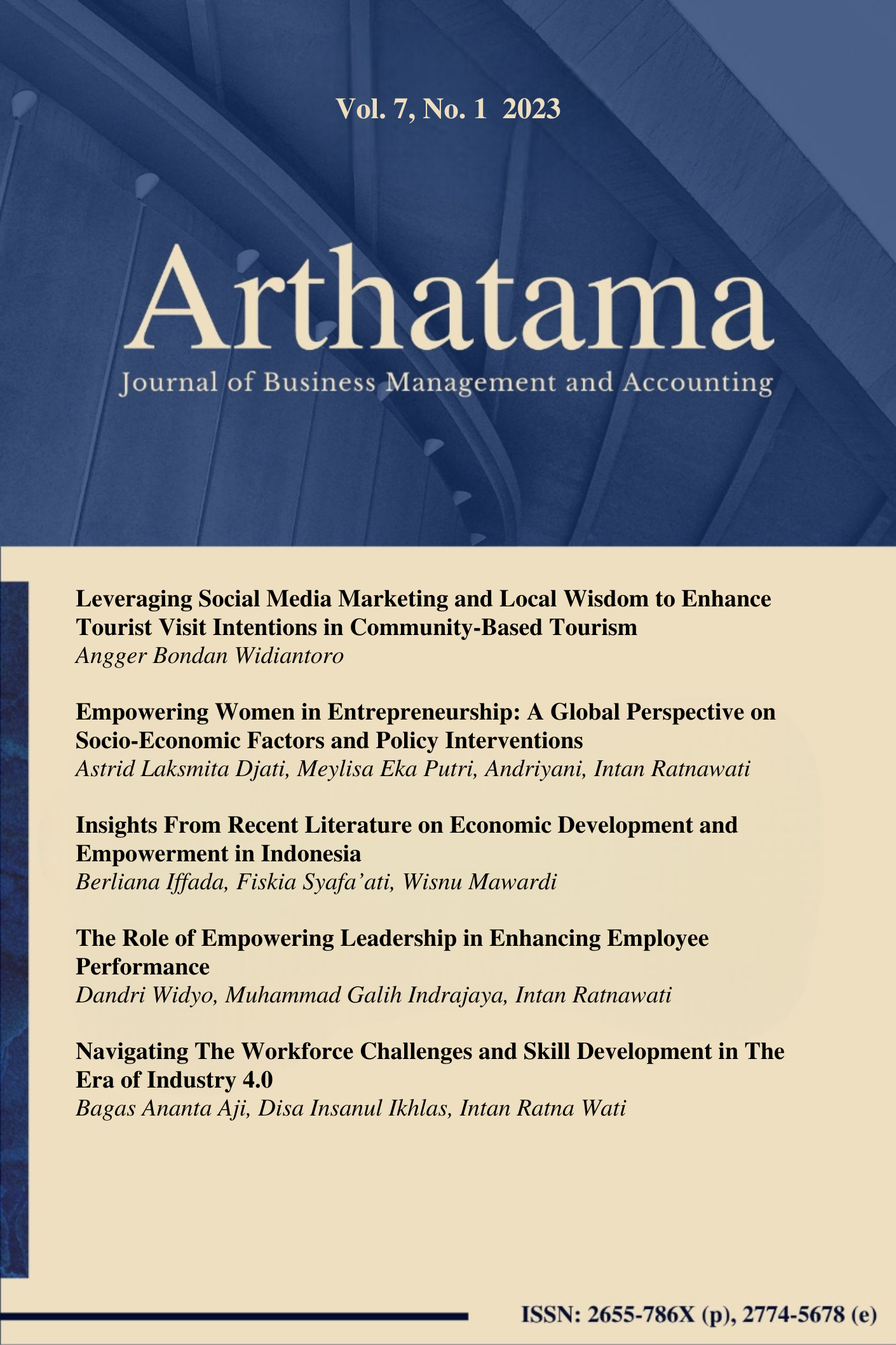
Navigating The Workforce Challenges and Skill Development in The Era of Industry 4.0
DOI:
https://doi.org/10.54518/art.7.1.2023.468Keywords:
Employee Competencies, Industry 4.0, Skill Development, Digital Transformation, Organizational PerformanceAbstract
This study aims to explore the impact of employee competencies on organizational performance in the context of Industry 4.0, focusing on the essential skills required to adapt to technological advancements. With the rapid development of digital technologies and automation, employees are expected to possess a diverse set of competencies, including technical, digital, social, and personal skills. These competencies play a crucial role in addressing complex problems, fostering creativity, and ensuring organizational growth. A qualitative research approach is utilized, starting with a literature review to establish a theoretical framework on employee competencies, technological adaptation, and training practices. Data is collected through interviews with industry experts, HR managers, and employees to understand the specific challenges and opportunities related to workforce skill development. Data analysis is conducted using a descriptive approach, identifying recurring themes and trends in the competencies needed for Industry 4.0. The findings indicate that companies must prioritize continuous training and development programs to equip employees with the necessary skills to thrive in a rapidly evolving digital environment. The study highlights the importance of investing in employee competencies to drive organizational success, emphasizing the need for a proactive approach to skill development in an increasingly automated world
References
Abulibdeh, A., Zaidan, E., & Abulibdeh, R. (2024). Navigating the confluence of artificial intelligence and education for sustainable development in the era of industry 4.0: Challenges, opportunities, and ethical dimensions. Journal of Cleaner Production, 140527.
Asif, M. (2021). Evaluation of factors affecting carbon accounting information disclosure: A case of ASEAN countries. Arthatama, 5(2), 39-50.
Baird, A. M., & Parayitam, S. (2019). Employers’ ratings of importance of skills and competencies college graduates need to get hired: Evidence from the New England region of USA. Education+ Training, 61(5), 622-634.
Bonaccio, S., Connelly, C. E., Gellatly, I. R., Jetha, A., & Martin Ginis, K. A. (2020). The participation of people with disabilities in the workplace across the employment cycle: Employer concerns and research evidence. Journal of business and psychology, 35(2), 135-158.
Brahma, M., Tripathi, S. S., & Sahay, A. (2021). Developing curriculum for industry 4.0: digital workplaces. Higher Education, Skills and Work-Based Learning, 11(1), 144-163.
Cohen, Y., Naseraldin, H., Chaudhuri, A., & Pilati, F. (2019). Assembly systems in Industry 4.0 era: a road map to understand Assembly 4.0. The International Journal of Advanced Manufacturing Technology, 105, 4037-4054.
Dhanpat, N., Buthelezi, Z. P., Joe, M. R., Maphela, T. V., & Shongwe, N. (2020). Industry 4.0: The role of human resource professionals. SA Journal of Human Resource Management, 18(1), 1-11.
Farrell, L., Newman, T., & Corbel, C. (2021). Literacy and the workplace revolution: a social view of literate work practices in Industry 4.0. Discourse: Studies in the cultural politics of education, 42(6), 898-912.
Flores, E., Xu, X., & Lu, Y. (2020). Human Capital 4.0: a workforce competence typology for Industry 4.0. Journal of Manufacturing Technology Management, 31(4), 687-703.
Gajdzik, B., & Wolniak, R. (2022). Smart production workers in terms of creativity and innovation: The implication for open innovation. Journal of Open Innovation: Technology, Market, and Complexity, 8(2), 68.
Goulart, V. G., Liboni, L. B., & Cezarino, L. O. (2022). Balancing skills in the digital transformation era: The future of jobs and the role of higher education. Industry and Higher Education, 36(2), 118-127.
Grybauskas, A., Stefanini, A., & Ghobakhloo, M. (2022). Social sustainability in the age of digitalization: A systematic literature Review on the social implications of industry 4.0. Technology in Society, 70, 101997.
Hernandez-de-Menendez, M., Morales-Menendez, R., Escobar, C. A., & McGovern, M. (2020). Competencies for industry 4.0. International Journal on Interactive Design and Manufacturing (IJIDeM), 14, 1511-1524.
Hung, J., & Ramsden, M. (2021). The application of human capital theory and educational signalling theory to explain parental influences on the Chinese population’s social mobility opportunities. Social Sciences, 10(10), 362.
Khang, A., Jadhav, B., & Birajdar, S. (2023). Industry revolution 4.0: workforce competency models and designs. In Designing workforce management systems for industry 4.0 (pp. 11-34). CRC Press.
Koutroubas, V., & Galanakis, M. (2022). Bandura’s social learning theory and its importance in the organizational psychology context. Psychology, 12(6), 315-322.
Kouzes, J. M., & Posner, B. Z. (2023). The leadership challenge: How to make extraordinary things happen in organizations. John Wiley & Sons.
Li, L. (2022). Reskilling and upskilling the future-ready workforce for industry 4.0 and beyond. Information Systems Frontiers, 1-16.
Mian, S. H., Salah, B., Ameen, W., Moiduddin, K., & Alkhalefah, H. (2020). Adapting universities for sustainability education in industry 4.0: Channel of challenges and opportunities. Sustainability, 12(15), 6100.
Mukhuty, S., Upadhyay, A., & Rothwell, H. (2022). Strategic sustainable development of Industry 4.0 through the lens of social responsibility: The role of human resource practices. Business Strategy and the Environment, 31(5), 2068-2081.
Quyen, T. H. (2020). The relationship between green procurement practices and organizational performance in the manufacturing industry of Vietnam. Arthatama, 4(1), 1-16.
Reaves, J. (2019). 21st-century skills and the fourth industrial revolution: a critical future role for online education. International Journal on Innovations in Online Education, 3(1).
Rumjaun, A., & Narod, F. (2020). Social learning theory—albert bandura. Science education in theory and practice: An introductory guide to learning theory, 85-99.
Shah, M. H. (2022). Impact of green marketing strategy on business performance-mediating role of corporate image in construction industry of Kenya. Arthatama, 6(1), 1-11.
Singh, R. K., Agrawal, S., & Modgil, S. (2022). Developing human capital 4.0 in emerging economies: an industry 4.0 perspective. International Journal of Manpower, 43(2), 286-309.
Downloads
Published
How to Cite
Issue
Section
License

This work is licensed under a Creative Commons Attribution-ShareAlike 4.0 International License.
This is a state of publication that makes writers respect the copyright of their articles and enables us to ensure full copyright protection and to disseminate international journals. Authors are asked to transfer copyrights to ensure the widest possible dissemination of information. Notification will be sent to the relevant Author who confirms receipt of the manuscript. If citations from other copyrighted works are included, the Author must obtain written permission from the copyright owner and give credit to the source in the article.