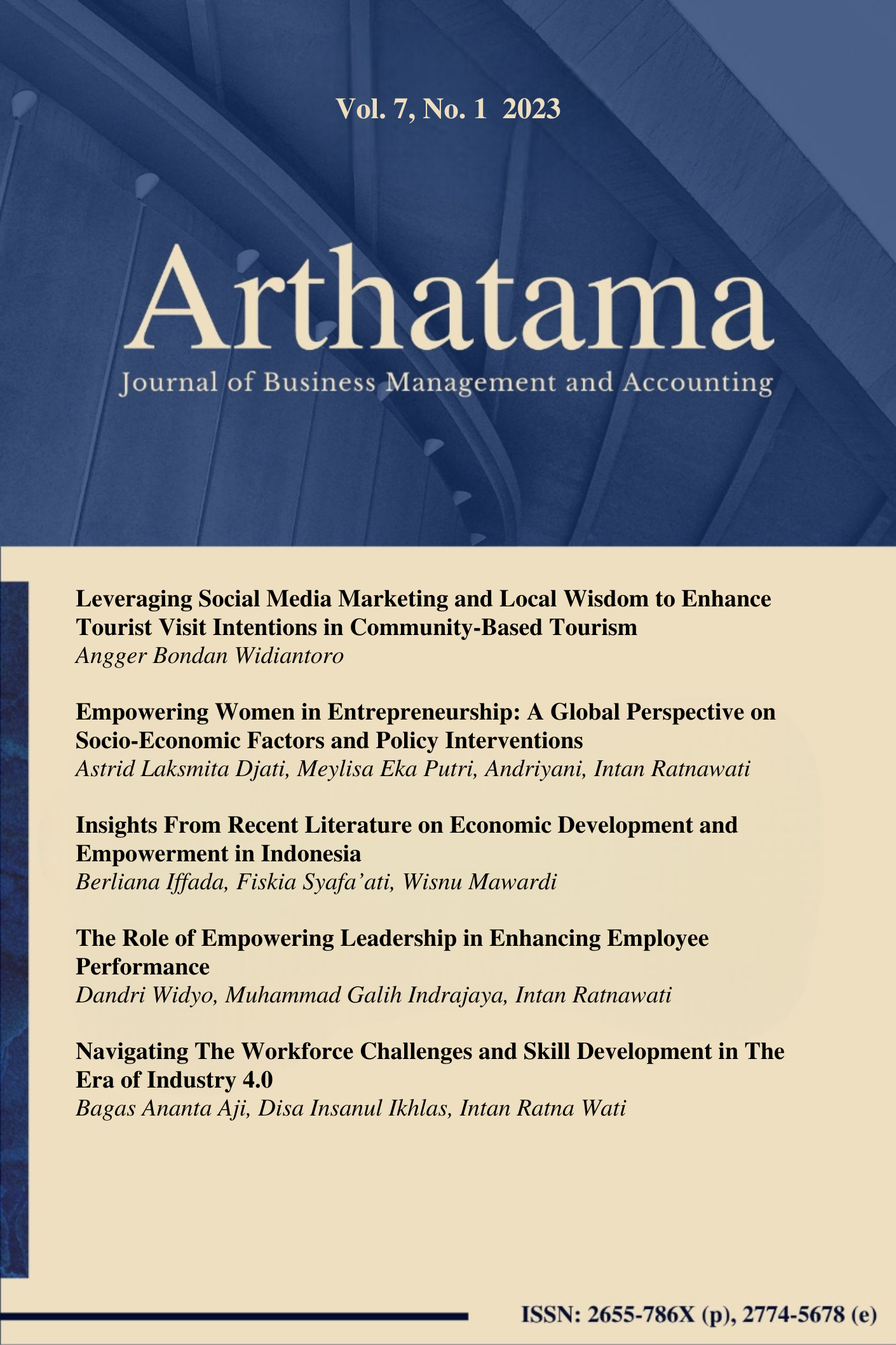
Insights From Recent Literature on Economic Development and Empowerment in Indonesia
DOI:
https://doi.org/10.54518/art.7.1.2023.466Keywords:
Economic Development, Regional Disparities, Sustainable Growth, Green Economy, Digital TechnologiesAbstract
This paper examines the economic development challenges and opportunities in Indonesia, focusing on regional disparities, poverty alleviation, and sustainable growth. Through an analysis of various studies, it highlights the importance of addressing issues such as demographic pressures, inadequate infrastructure, financial constraints, and systemic inequalities that hinder development, especially in remote and vulnerable regions. The research emphasizes the need for targeted government intervention, infrastructure investment, and policies that promote inclusive growth and empower marginalized communities. Additionally, the paper explores the role of sustainable innovation, particularly in agriculture, fisheries, and tourism, as a means to drive inclusive economic development. The potential of the green economy and digital technologies is also discussed, with a focus on how these sectors can contribute to environmental sustainability and job creation. The study calls for comprehensive, well-designed policies that align economic development with social welfare and environmental goals, ensuring long-term prosperity for all segments of the population. Overall, the findings suggest that Indonesia’s future economic success depends on strategic efforts to integrate sustainable practices, improve infrastructure, and foster inclusive growth at both the national and local levels.
References
Apriantoro, M. S., Widyastuti, H., El Ashfahany, A., & Murtadla, A. A. (2024). Sustainability and green economy in developmental paradigms: A bibliometric analysis of scholarly trends and transformations. Indonesian Interdisciplinary Journal of Sharia Economics (IIJSE), 7(3), 4587-4610.
Asif, M. (2021). Evaluation of factors affecting carbon accounting information disclosure: A case of ASEAN countries. Arthatama, 5(2), 39-50.
Azwar, A. (2023). The role of Islamic philanthropy in green economy development: Case in Indonesia. International Journal of Islamic Economics and Finance Research, 6(2 December), 40-55.
Cillo, V., Petruzzelli, A. M., Ardito, L., & Del Giudice, M. (2019). Understanding sustainable innovation: A systematic literature review. Corporate Social Responsibility and Environmental Management, 26(5), 1012-1025.
Dahliah, D. (2020). Analysis and strategy of economic development policy for SMEs in Indonesia. The Journal of Asian Finance, Economics and Business, 7(5), 103-110.
Donthu, N., Kumar, S., Mukherjee, D., Pandey, N., & Lim, W. M. (2021). How to conduct a bibliometric analysis: An overview and guidelines. Journal of business research, 133, 285-296.
Firmansyah, C. A., & Sihaloho, E. D. (2021). The effects of women empowerment on indonesia’s regional economic growth. Jurnal Ekonomi Pembangunan: Kajian Masalah Ekonomi dan Pembangunan, 22(1), 12-21.
Fitrah, R., & Soemitra, A. (2022). Green Sukuk for sustainable development goals in Indonesia: a literature study. Jurnal Ilmiah Ekonomi Islam, 8(1), 231-240.
Hanuun, N. N. P., Negara, M. R. P., & Aripin, Z. (2023). Entrepreneurial empowerment in creating sustainable development in developing countries: to what extent do they strengthen and contribute to each other?. In Journal of Jabar Economic Society Networking Forum (Vol. 1, No. 1, pp. 54-63).
Hudaefi, F. A., & Heryani, N. (2019). The practice of local economic development and Maqāṣid al-Sharī ‘ah: Evidence from a Pesantren in West Java, Indonesia. International Journal of Islamic and Middle Eastern Finance and Management, 12(5), 625-642.
Indarti, N., Rostiani, R., Megaw, T., & Willetts, J. (2019). Women’s involvement in economic opportunities in water, sanitation and hygiene (WASH) in Indonesia: Examining personal experiences and potential for empowerment. Development Studies Research, 6(1), 76-91.
Irawan, B., Rofiah, C., Asfahani, A., Sufyati, H. S., & Hasan, W. (2023). Empowering Micro Small and Medium Enterprises (MSMEs) to Improve Global Economic Welfare. International Assulta of Research and Engagement (IARE), 1(2), 75-86.
Iswanto, D. (2024). Sustainable Development Goals (SDGs): Economic Transformation Towards Sustainable Development. Journal of Economic Growth and Development Review, 19-26.
Kelly-Fair, M., Gopal, S., Koch, M., Pancasakti Kusumaningrum, H., Helmi, M., Khairunnisa, D., & Kaufman, L. (2022). Analysis of land use and land cover changes through the lens of SDGs in Semarang, Indonesia. Sustainability, 14(13), 7592.
Latifah, E. (2024). Fiqh al-Bī'ah and the Concept of Green and Blue Economy for Achieving Sustainable Development in the Context of SDGs. Invest Journal of Sharia & Economic Law, 4(1), 74-99.
Nuringsih, K., & Nuryasman, M. N. (2021). The role of green entrepreneurship in understanding Indonesia economy development sustainability among young adults. Studies of Applied Economics, 39(12).
Quyen, T. H. (2020). The relationship between green procurement practices and organizational performance in the manufacturing industry of Vietnam. Arthatama, 4(1), 1-16.
Sagar, G., Anand, B., Perumalla Varalaxmi, A. S., & Raj, S. (2023). The role of entrepreneurship in economic growth and development. Journal of Survey in Fisheries Sciences, 10(1S), 5940-5955.
Saleh, H., Surya, B., Annisa Ahmad, D. N., & Manda, D. (2020). The role of natural and human resources on economic growth and regional development: With discussion of open innovation dynamics. Journal of Open Innovation: Technology, Market, and Complexity, 6(4), 103.
Shah, M. H. (2022). Impact of green marketing strategy on business performance-mediating role of corporate image in construction industry of Kenya. Arthatama, 6(1), 1-11.
Soeswoyo, D. M., Jeneetica, M., Dewi, L., Dewantara, M. H., & Asparini, P. S. (2021). Tourism potential and strategy to develop competitive rural tourism in Indonesia. International Journal of Applied Sciences in Tourism and Events, 5(2), 131-141.
Sukmawati, D., & Maryanti, R. (2022). Development of education and economic circulation in supporting local potential as community empowerment efforts amid the Covid-19 pandemic. Indonesian Journal of Multidiciplinary Research, 1(2), 235-250.
Surya, B., Syafri, S., Sahban, H., & Sakti, H. H. (2020). Natural resource conservation based on community economic empowerment: Perspectives on watershed management and slum settlements in Makassar City, South Sulawesi, Indonesia. Land, 9(4), 104.
Wibowo, A. (2023). Global Economic Challenges for Indonesia: Equitable Development for Sustainable Prosperity. In Prosiding Seminar Teknologi, Akuntansi, Bisnis, Ekonomi, dan Komunitas (Vol. 3, pp. 23-40).
Downloads
Published
How to Cite
Issue
Section
License

This work is licensed under a Creative Commons Attribution-ShareAlike 4.0 International License.
This is a state of publication that makes writers respect the copyright of their articles and enables us to ensure full copyright protection and to disseminate international journals. Authors are asked to transfer copyrights to ensure the widest possible dissemination of information. Notification will be sent to the relevant Author who confirms receipt of the manuscript. If citations from other copyrighted works are included, the Author must obtain written permission from the copyright owner and give credit to the source in the article.